By Sofia Arias, University College Dublin student, MLIS Library & Information Studies
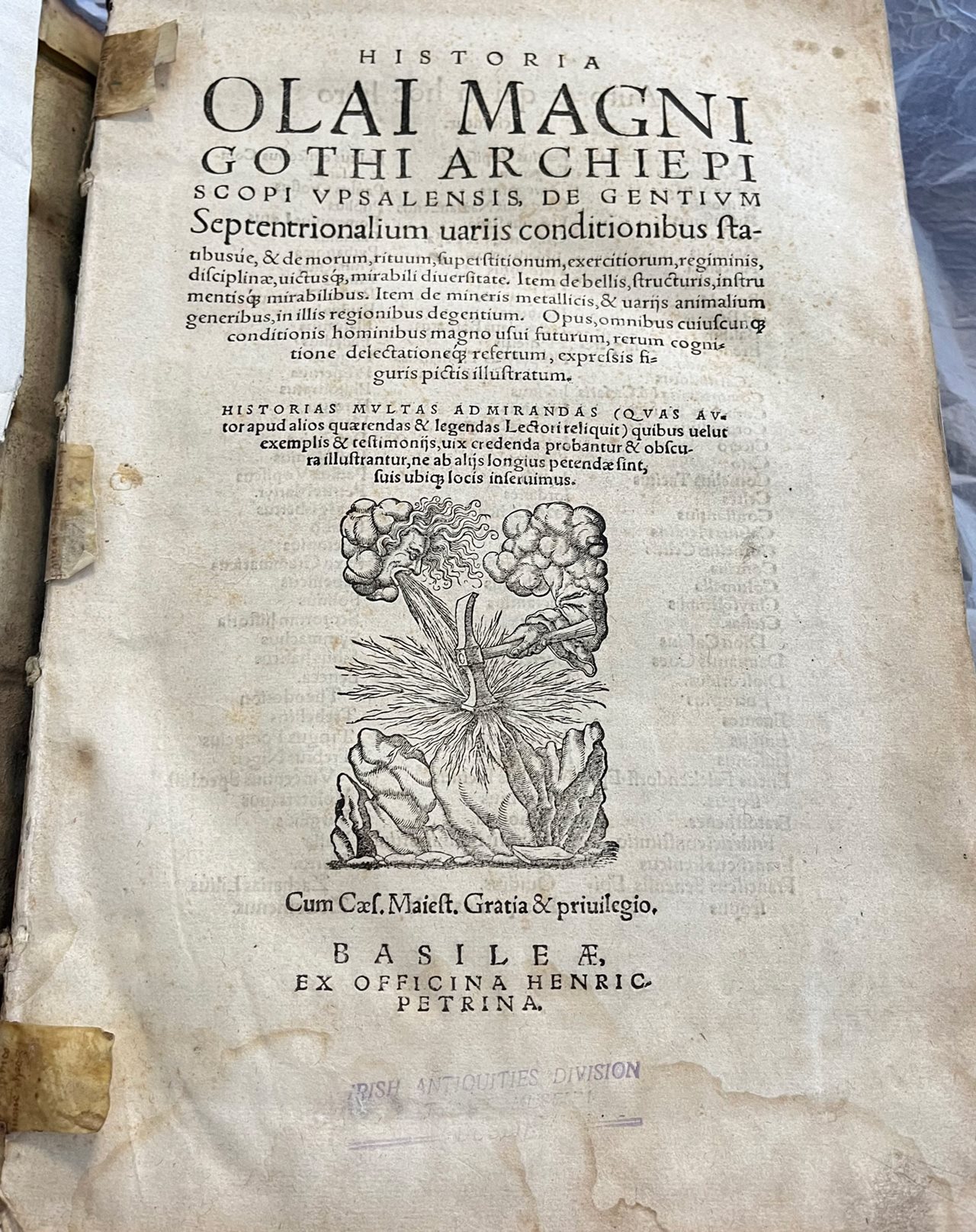
Did you know the oldest book in the National Museum of Ireland’s library is almost 500 years old? The Historia de gentium Septentrionalibus (or, A Description of the Northern Peoples) was originally published in Rome in 1555. The Museum’s library holds a copy published in Basel, Switzerland in 1567 – over 459 years old!
The Historia was written by Olaus Magnus, Archbishop of Uppsala (actually largely ceremonial title conferred upon him by Pope Paul III) and details the culture, lifestyle, and mythology of ancient Sweden. It was also subtly critical of Gustav Vasa, the Swedish king who’d exiled Magnus and his brother Johannes from the country during the Swedish Reformation. Today, it is most renowned for its fabulous woodcut engravings, which depict a range of subjects from everyday agricultural life to sea monsters devouring ships whole.
Some Context
Though first published in Latin, the Historia has been widely translated and abridged. Considered one of the ‘indispensible [sic] folio[s] of the northern European renaissance,’ its publication roughly coincided with the rise of the printing trade.
The Historia, along with several Latin translations of the Old Norse Edda in the 17th century, helped spark a revival of interest across Europe in Viking culture. Vikings were of special interest to the Romantics, who frequently recounted their exploits with overtones of heroism and adventure. In the UK and elsewhere, buildings were constructed with runic dragon motifs or influenced by Scandinavian stave churches. The text of the Historia was referenced by Sir Walter Scott, and a copy even made its way into Queen Victoria’s hands!
Caring for vellum
The Historia is bound in a material called vellum – that is, calf skin which has been prepared for writing or printing. To prepare vellum, the skin is first removed from an animal, along with any hair or flesh. It is chemically treated and stretched on a wooden frame. Here, it is scraped with a curved blade called a lunellum by a parchment maker. The skin is scraped and dried until it is the correct thickness and ready to receive ink. This process is lengthy and involved – this makes vellum far more expensive than the paper we use today. Traditionally, vellum is used for religious documents and in acts of Parliament.
Vellum and parchment (the term we use for any animal skin used for writing) are highly capable of attracting and holding water from moisture in their environment. This means parchment documents and books bound in vellum, like the Historia Olai Magni, must be kept within a narrow range of humidity – too humid and they might mould; too dry and they may become brittle. For archivists and librarians, vellum presents a unique challenge.
For more information on this book and other objects like it, visit the National Museum of Ireland’s Collections Online.
References
National Archives. (2016). Differences between Parchment, Vellum, and Paper [Online]. Available from: https://www.archives.gov/preservation/formats/paper-vellum.html [accessed 27 May 2026].
Royal Collection Trust. (n.d.). Historia Olai Magni gothi archiepiscopi Upsalensis De gentium septentrionalium [Online]. Available from: https://www.rct.uk/collection/1046996/historia-olai-magni-gothi-archiepiscopi-upsalensis-de-gentium-septentrionalium [accessed 27 May 2026].
Wawn, A. (2000). The Vikings and the Victorians: inventing the old north in nineteenth-century Britain. Rochester: D.S. Brewer.